
160 Robinson Road, #14-04 Singapore Business Federation Center, Singapore (068914)
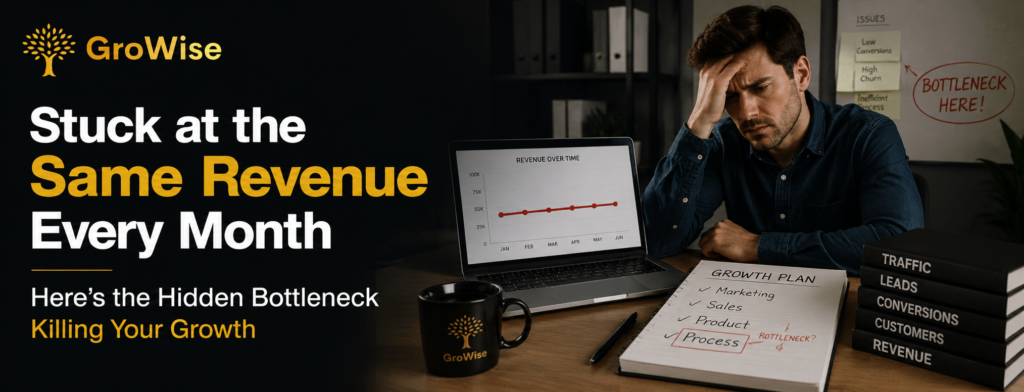
Stuck at the Same Revenue Every Month Here’s the Hidden Bottleneck Killing Your Growth
Every business reaches a point where growth starts to feel frustratingly slow. Sales numbers stay almost identical month after month, despite increased effort, longer working hours, and larger marketing budgets. Leaders often assume the solution is simple: hire more salespeople, spend more on advertising, or launch new campaigns. Yet the problem usually runs much deeper.
The real issue is often an invisible operational bottleneck hiding inside the business itself. Without identifying and fixing that bottleneck, even the best marketing and sales initiatives struggle to create consistent results. A strong revenue optimization strategy can help businesses uncover the hidden problems that quietly limit growth and prevent scaling.
The Illusion of Activity Without Progress
Many businesses confuse activity with productivity. Teams are busy attending meetings, following up on leads, preparing reports, and managing multiple tools. On the surface, everything appears active and functional. However, being busy does not always translate into measurable revenue growth.
One of the clearest warning signs is when revenue plateaus despite increasing operational effort. This situation often creates internal frustration because leadership expects higher output from a team that already feels overworked. The problem is rarely a lack of effort. Instead, the issue lies in systems, processes, and alignment.
This is where businesses begin experiencing serious business growth stagnation. The company keeps moving, but not moving forward.
The Hidden Bottleneck Most Businesses Ignore
In many cases, the bottleneck is not market demand. It is not competition either. The hidden problem is usually a disconnect between departments, customer experience, and sales execution.
For example:
- Marketing may generate leads that sales teams cannot convert.
- Sales teams may spend too much time on unqualified prospects.
- Customer onboarding may be slow and confusing.
- Revenue data may be fragmented across different systems.
- Leadership may lack visibility into pipeline performance.
These inefficiencies accumulate over time and quietly reduce growth potential. Even small operational delays can create major financial consequences when repeated across hundreds of leads or customers.
Businesses that successfully scale understand how to identify sales inefficiencies before they become long-term revenue blockers. They continuously evaluate workflows, customer interactions, and internal communication to ensure every stage of the revenue process supports growth.
Why More Leads Are Not Always the Answer
When revenue slows down, many companies immediately focus on lead generation. While generating more leads can help, it is often ineffective when the sales process itself contains friction.
Imagine pouring water into a bucket filled with holes. No matter how much water you add, the bucket never fills properly. The same happens in businesses with poor sales alignment and weak operational systems.
Instead of simply increasing lead volume, companies should evaluate conversion rates, sales cycle duration, customer retention, and team productivity. Often, improving existing systems creates faster growth than acquiring additional leads.
An effective revenue optimization strategy focuses on improving the efficiency of the entire revenue engine rather than just expanding top-of-funnel activity.
The Cost of Poor Revenue Visibility
Another overlooked bottleneck is the lack of reliable revenue visibility. Many businesses rely on outdated spreadsheets, disconnected CRM systems, or inconsistent reporting methods. As a result, leadership teams struggle to make confident decisions.
Without accurate insights, forecasting becomes reactive rather than strategic. Businesses cannot properly allocate resources, predict future cash flow, or identify underperforming areas.
Organizations that invest in better reporting systems can significantly improve revenue forecasting and make faster, data-driven decisions. Accurate forecasting helps leadership identify trends early, reduce uncertainty, and respond proactively to market changes.
When businesses understand where revenue is being lost, they gain the ability to optimize performance before problems escalate.
Customer Experience Is a Revenue Driver
Many companies underestimate the financial impact of customer experience. They focus heavily on acquisition while neglecting the journey customers experience after the initial interaction.
A slow response time, confusing onboarding process, or inconsistent communication can quietly damage conversion rates and retention. Customers today expect smooth, personalized experiences at every touchpoint.
Businesses that prioritize customer experience are far more likely to build long-term loyalty and sustainable revenue growth. One of the most effective ways to strengthen performance is to optimize customer journey processes across marketing, sales, onboarding, and support.
When customer interactions become simpler and more valuable, businesses naturally improve retention, referrals, and lifetime customer value.
Why Scaling Requires Operational Discipline
Scaling revenue is not only about ambition. It requires operational discipline and repeatable systems. Businesses that depend entirely on founders or a few high-performing employees often struggle to sustain growth.
As organizations grow, complexity increases. Communication gaps widen, decision-making slows, and accountability becomes harder to maintain. Without proper systems, growth eventually creates chaos instead of momentum.
This is why scalable companies focus heavily on structure, process documentation, and performance management. They understand that predictable growth comes from operational consistency, not random bursts of effort.
A modern revenue optimization strategy aligns sales, operations, marketing, and customer success into one coordinated growth system. Instead of isolated teams working independently, the organization operates with shared goals and measurable outcomes.
Retention Is Often More Profitable Than Acquisition
One of the biggest mistakes businesses make is focusing exclusively on acquiring new customers while ignoring existing ones. Customer retention often delivers higher profitability because retaining a customer is usually less expensive than acquiring a new one.
Businesses that maintain strong relationships, deliver ongoing value, and provide proactive support create recurring revenue opportunities that compound over time.
For subscription-based or service-driven businesses, the ability to increase monthly recurring revenue is often the key difference between unstable growth and long-term scalability.
Recurring revenue creates predictability, improves financial planning, and reduces dependence on constant lead generation. It also gives businesses greater resilience during economic uncertainty.
Leadership Alignment Matters More Than Ever
Another hidden growth bottleneck is leadership misalignment. Different departments often operate with conflicting priorities, disconnected metrics, and unclear accountability.
For example:
- Marketing focuses on lead volume.
- Sales focuses on short-term deals.
- Customer success focuses on retention.
- Finance focuses on cost control.
Without alignment, teams unintentionally work against each other. Revenue growth becomes inconsistent because every department defines success differently.
Strong leadership teams establish unified revenue goals and ensure every function contributes toward the same business objectives. Clear communication and accountability create faster execution and better decision-making across the organization.
A successful revenue optimization strategy requires leadership to view growth as a company-wide responsibility rather than just a sales function.
Breaking Through the Revenue Plateau
Breaking through stagnant revenue requires businesses to stop chasing surface-level fixes and start addressing root causes. Growth challenges rarely come from a single issue. Instead, they emerge from a combination of inefficiencies, poor alignment, weak visibility, and inconsistent customer experiences.
The businesses that achieve sustainable growth are the ones willing to audit their systems honestly, embrace operational improvements, and build scalable revenue processes.
Revenue plateaus are not permanent. In many cases, they are signals that the business has outgrown its current systems and needs a more strategic approach to scaling.
Turn Revenue Bottlenecks Into Growth Opportunities
At GroWise, we help businesses break free from stalled growth with on-demand sales expertise, revenue infrastructure, and go-to-market execution designed for real impact. Whether founders are stepping out of the sales seat or leaders are scaling teams for market expansion, we work alongside them to build productive systems that drive measurable results. Our approach focuses on optimizing sales performance, improving team productivity, and creating sustainable revenue growth without the burden of long-term overhead or slow hiring cycles.
Final Thoughts
By focusing on process efficiency, customer experience, forecasting accuracy, and team alignment, businesses can unlock new levels of performance and sustainable growth. The right revenue optimization strategy does not just increase revenue temporarily. It creates the foundation for long-term business expansion and operational excellence.
FAQs
1. Why does business revenue stop growing even with increased effort?
Revenue growth often slows because of hidden operational bottlenecks such as poor sales alignment, inefficient processes, weak forecasting, or customer experience gaps.
2. What are the common signs of revenue stagnation?
Common signs include flat monthly sales, declining conversion rates, inconsistent forecasting, slow sales cycles, and reduced team productivity despite increased activity.
3. How can businesses identify revenue bottlenecks?
Businesses can identify bottlenecks by reviewing sales processes, customer journeys, reporting systems, team performance, and operational workflows to uncover inefficiencies.
4. Why is customer experience important for revenue growth?
A smooth customer experience improves retention, increases referrals, strengthens loyalty, and creates more opportunities for long-term recurring revenue.
5. What is the role of a revenue optimization strategy in scaling a business?
A revenue optimization strategy helps align sales, marketing, operations, and customer success to improve efficiency, forecasting, and sustainable business growth.