Get In touch
Email contactus@growise.sg
These days, “fractional” is the word of the moment, right next to AI. Everyone seems to be offering fractional leadership services, but what does that really mean?
At its best, a fractional leader is a seasoned executive you bring on board for a fraction of the cost of a full-time hire. They help you shape strategy before you’re ready to commit to roles like Chief Revenue Officer, Head of Sales, or Head of Market Entry.
What a fractional leader is not? Someone “in between jobs” trying to sneak into your company with the hidden agenda of securing a permanent role. That happens, and it can be a natural move, but it shouldn’t be the reason you create the role. As a founder or CEO, you have a clear choice: either hire full-time or hire fractional. Nothing pseudo in between.
So, how do you separate good from great?
Before you dive into strategy, make sure you know who you’re working with. The wrong advisor can cost you far more than the right one will ever save.
If you’re investing $30,000 or more in a go-to-market strategy, don’t skip due diligence. The first step is always vetting.
Reference checks: Take thirty minutes to call them. Strong references reveal how the advisor really operates.
Track record: Look for a clear concept, product, or methodology; not someone just riding the AI wave.
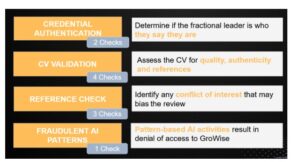
Structured checks: From credential authentication to spotting fraudulent AI patterns, every step helps ensure you hire real expertise. See below A rigorous vetting process isn’t bureaucracy, it’s your first layer of protection. Done well, it helps you avoid costly mistakes and ensures your investment is in the hands of someone who can truly deliver results.
Before you sign anything, be clear on what you actually need.
Specific problem to solve? Define clear KPIs and outcomes so both sides know what success looks like. For example, “Increase conversion rate from lead to signature by 15% in Q2” is far better than “help us sell more.”
Need a sounding board? Start small with a 10-hour retainer. This gives you space to test chemistry, thinking, and value without overcommitting.
Need execution? Then treat your fractional leader like an integrated team member. Set up business reviews, progress reviews, lead conversion tracking, and accountability structures. Without these, you’re just outsourcing and not building leadership.
Clear scoping avoids scope creep, protects your investment, and sets the foundation for success.
Every consultant can drop “AI,” “scalable GTM,” or “hypergrowth” into their pitch. But can they back it up?
Do they reference trusted sources like Gartner, McKinsey, or industry benchmarks?
Do they share a repeatable process — or are they improvising?
Most importantly, can they explain how they got their last big win? Not just “we grew revenue 3x,” but which levers they pulled and why. Apply vetting principles: pick three clear criteria (e.g., credibility, repeatable frameworks, and proven results) and stick to them. Always get a second opinion, a second offer, and compare. And start small: one project, one month. If it works, then scale into a retainer. Great consultants don’t sell you “off the shelf” solutions.
When reviewing a proposal, ask yourself: Do I see my business reflected in this? If it looks like a template, beware.
Push them to answer: Why are you a fractional leader? Why are you a consultant? The best ones have a clear, authentic reason, maybe they thrive on solving diverse problems, or they want to share lessons from multiple industries. If the answer is “I’m just trying it out,” that’s a red flag.
Look for proposals and strategies that feel yours, not recycled. Fit matters as much as expertise.
Context is everything. A consultant who drove success in Europe may fail miserably in Southeast Asia if they don’t understand local buying behavior, pricing sensitivity, or regulatory nuances.
Ask for proof of credibility in your target market — case studies, client references, or even evidence of lived experience. A great advisor doesn’t just give advice; they bring a playbook. If you see them pasting ChatGPT outputs into PowerPoint, you’re not getting a consultant, you’re getting a student. Market expertise separates those who can tell you what should work from those who know what does work.
Here’s the uncomfortable truth: great go-to-market experts aren’t cheap. And they shouldn’t be.
If you expect a seasoned fractional leader at student rates, you’ll get beginner-level results. Think of it this way: ChatGPT costs $300 a year and 400 million average users leverage it daily. It’s a great tool for sure but if you compare that to a GTM leader’s day rate, you’ll be disappointed. But ChatGPT won’t set your strategy, coach your team, or run business reviews. A fractional leader will.
The ROI comes faster than most realize. Because they’re not just “helping out” — they’re taking things off your plate and directly driving outcomes. The question isn’t what they cost, but how quickly they pay for themselves.
Fractional leadership can be an incredible solution when used correctly. But don’t confuse “fractional” with “cheap” or “temporary.” A great fractional leader is strategic, tested, and brings you measurable outcomes. Start small, vet properly, and always ask yourself: is this advisor truly great or just good enough?
Sources: GroWise (2025)

Seasoned Revenue Leader across Europe and APAC, with experience across IBM, Cisco and Gartner
Email contactus@growise.sg